
Executive Summary
The world’s energy debate has always been a debate about trade-offs: firm sources such as nuclear and hydro are reliable but cannot scale freely or be exported; variable sources such as wind and solar are cheap and clean but intermittent, imposing heavy balancing costs on the grid. Space-based solar power (SBSP) is the first technology to escape this trade-off. Measured against seven tests of an ideal energy source — reliability, affordability, sustainability, sovereignty, scalability, exportability and grid value — SBSP is the only source that scores strongly on all seven at once.

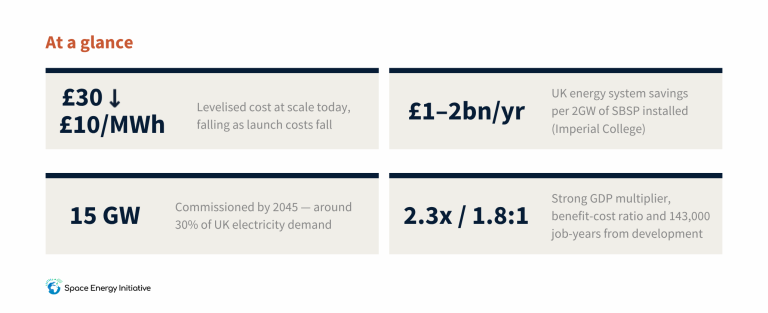
SBSP captures uninterrupted sunlight in orbit and beams it to receivers sited near demand, delivering continuous, dispatchable, low-carbon power that can be redirected between markets electronically rather than down fixed and costly cables. Space Solar’s analysis points to a levelised cost of around £30/MWh at scale at today’s launch costs, below every firm source and well below the true system cost of every variable source, falling towards £10/MWh as launch costs drop. Crucially, SBSP requires no scientific breakthroughs: every subsystem has already been demonstrated, so the task ahead is engineering and scaling rather than discovery.
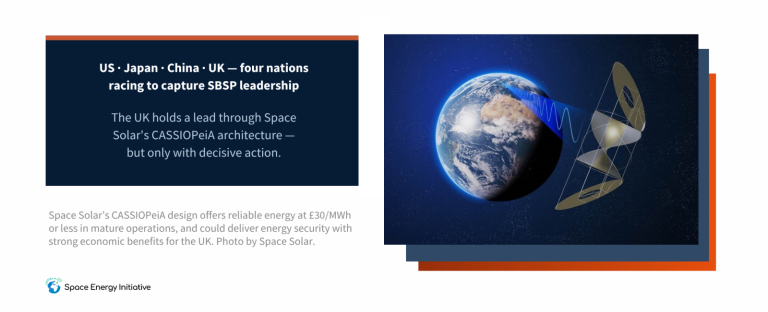
A global race to capture this opportunity is already under way. In the US, Overview Energy has agreed to sell Meta 1GW of power from an SBSP concept and the US Air Force is investigating the technology for remote power in the Indo-Pacific; Japan is targeting its first orbital power-beaming demonstrator this year; and China’s programme now extends to military applications. The UK holds a genuine and rare lead through Space Solar’s patented CASSIOPeiA architecture, but that lead is fragile: without near-term public funding to de-risk a first demonstrator, the UK will cede the ground and the supply chain, high-value jobs and energy sovereignty that come with it, just as it did with the jet engine, the computer and graphene. SpaceX is rapidly establishing PhotoVoltaics manufacturing and Starship launch capacity with the stated goal to deploy 100GW per year of power in space within 5 years.
A Credible, Near-Term Path
A credible, near-term path. The sector’s pathway to a first pilot plant is achievable within five years, building incrementally on technology already validated on the ground and in orbit, with a credible route from there to meaningful commercial scale by midcentury.
Along the way. This funding buys more than the end goal: each stage builds capability and value in its own right. Wireless power transmission and in-space robotic assembly alone are multi-billion pound global opportunities by 2030.

Strategic Advantage for the UK
The UK has the highest industrial electricity prices in the developed world, a direct brake on its ambition to be a competitive home for AI and advanced manufacturing. SBSP offers a route to firm, low-cost, sovereign power that reduces this burden without the multi-decade timelines of new nuclear or fusion, reconciling the UK’s AI-superpower ambitions with its energy-cost and sustainability goals within the window in which demand is arriving. It also positions the UK to capture the industrial, economic and export benefits of a technology it is uniquely placed to lead, rather than watching another nation capture the value, as happened with the jet engine, the computer and graphene.
Energy Resilience and Abundance
SBSP delivers clean electricity to remote, underserved, or disaster-affected regions without dependence on terrestrial grid infrastructure: rectenna sites can be built quickly and sited flexibly, strengthening resilience against weather, conflict, or supply-chain disruption. The same continuous, firm output also removes the storage and overbuild that intermittent renewables require, offering a route to genuinely abundant clean power, capable of meeting rising AI, industrial, and electrification demand without the land-use or grid-balancing constraints that limit terrestrial alternatives.
Building Public and Political Confidence
Public perception will shape how quickly SBSP can move from demonstrator to deployment. The phrase “power beamed from space” can misleadingly evoke a weapon; the reality is the opposite of dramatic. Transmission uses low-intensity radio waves, delivering a small fraction of the intensity of midday sunlight at the centre of the receiving site, and dispersing harmlessly if the guidance signal is lost. Addressing this clearly and early, in plain language, is one of the most important tasks in building the public and political confidence this technology needs to succeed.
The Ask
The Space Energy Initiative calls on the UK government to co-fund an orbital demonstrator, matching private investment to de-risk the next stage of development towards a MW-scale pilot plant within five years. This is a modest, near-term commitment set against the prize: a UK-led route to secure, low-cost, sovereign power and a domestic supply chain in a technology the UK is uniquely placed to lead.
- Co-fund an orbital demonstrator, matching private investment to de-risk the next stage
- Enable a MW-scale pilot plant in orbit within five years
- Build a UK-based space energy supply chain to capture high-value jobs and export opportunities
“SBSP is no longer a distant dream; it is an emerging engineering reality. With the right support now, it could become one of the defining energy technologies of the 21st century. The choice is stark: support it now and reap the benefits, or buy it from someone else later.”
Martin Soltau, Co-Founder, Space Energy Initiative & Felix Ritchie, Energy Working Group Lead
About the SEI
The SEI recognise the challenges of Net Zero, and the need for new baseload energy technologies to complement our intermittent renewables. The SEI will lead the development of Space Based Solar Power for the UK, offering large scale, safe, and secure energy day and night, through all seasons and weather. Through a structured and collaborative programme of design, research and technology demonstration, the SEI will promote integration and innovation between Space, Energy, Digital, and Manufacturing ecosystems.